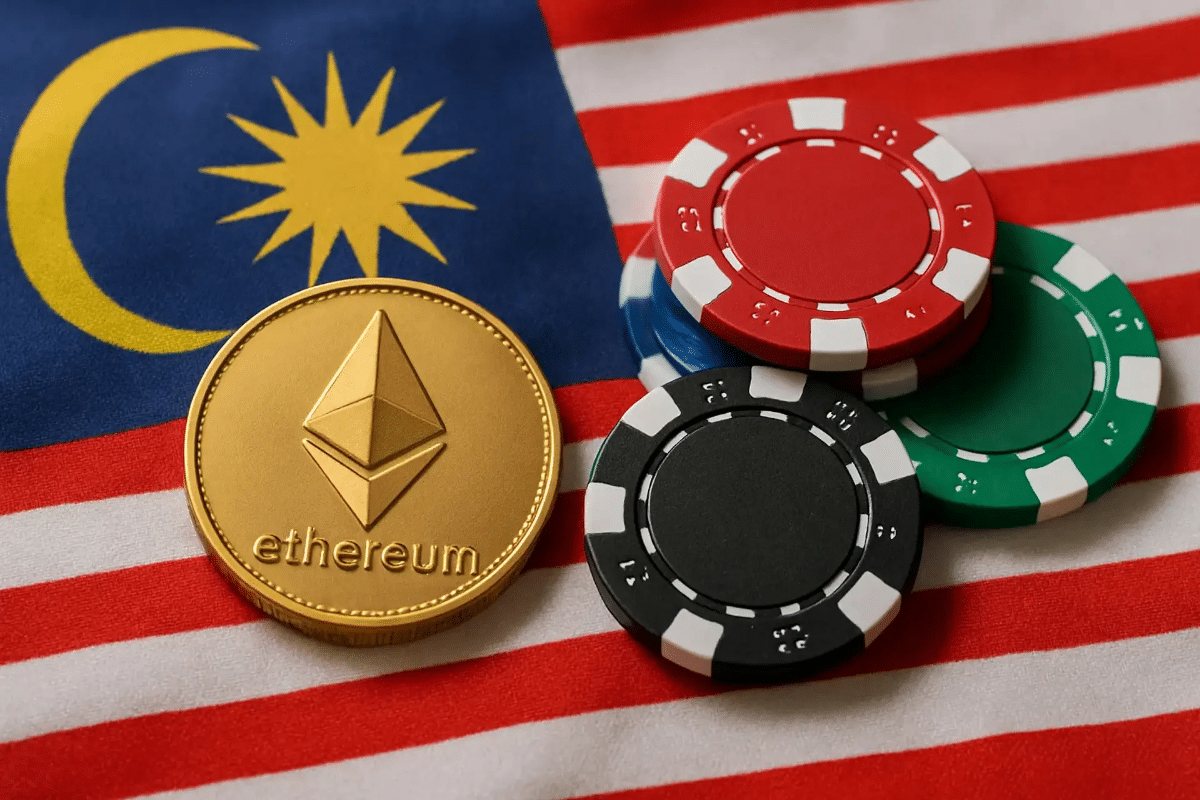
A quiet revolution is reshaping how Malaysians gamble online. Faced with banking blocks and stringent gambling laws, a growing number of players are turning to cryptocurrency, particularly stablecoins, to fund their accounts on offshore platforms. Globally, crypto casinos already account for roughly 17% of all iGaming bets. Within that wedge, stablecoins have emerged as the clear winner—80% of crypto casinos now offer USDT or USDC, and USDT alone commands around 60% of Web3 gambling transaction share.
In Malaysia, where online gambling occupies a complex legal space, the convenience and anonymity of crypto payments have accelerated adoption. At the same time, the government is intensifying its crackdown. Under the new Online Security and Safety Act (ONSA), which came into force on 1 January 2026, social media platforms face fines of up to RM10 million for failing to curb online gambling content.

Malaysia‘s Crypto Gambling Adoption – The Data
Precise figures for crypto gambling adoption in Malaysia are not published, but several data points paint a clear picture. Nationwide cryptocurrency ownership among internet users aged 18 and above has dropped to 15% from 20% in 2025, largely due to market volatility. However, this decline has not reduced gambling-related crypto activity. Globally, crypto gambling is projected to exceed $65 billion by the end of 2026, growing at a CAGR of approximately 12–15%.
Malaysia consistently ranks near the top of global Google search interest for online poker, and offshore operators actively serve Malaysian players in Bahasa Malaysia. Crypto casinos already account for about 17% of all iGaming bets globally, with Asia accounting for around 35% of crypto gambling adoption—a share projected to hit 40% by 2026. Within that Asian wedge, Malaysia contributes a substantial portion, driven by a tech‑savvy population and e‑wallet penetration exceeding 87%.
Industry estimates suggest that 40% to 60% of total cryptocurrency spot trading volume by Malaysian investors occurs on global exchanges, reflecting a migration toward international platforms that offer a wider range of digital assets and, crucially, gambling services. The number of Malaysians actively using cryptocurrencies is estimated at around 500,000 to 1 million, with the 25–40 age group forming the core demographic.
Malaysia Crypto Gambling Adoption Indicators (2026)
| Indicator | Value | Source |
|---|---|---|
| Global crypto gambling market (2026) | > $65 billion | ADVFN |
| Crypto share of global iGaming bets | ~17% | Quantumrun |
| Asia’s share of crypto gambling adoption | ~35% (projected 40% by 2026) | Quantumrun |
| Crypto casinos offering USDT/USDC | 80% | Quantumrun |
| Malaysian crypto ownership (internet users) | 15% (-5% from 2025) | Finder / The Edge |
The Regulatory Clampdown – ONSA and Up to RM10 Million Fines
The government has responded with legislation designed to disrupt the digital ecosystem that enables online gambling. The Online Security and Safety Act (ONSA) , which took effect on 1 January 2026, empowers the Malaysian Communications and Multimedia Commission (MCMC) to compel social media platforms to remove prohibited content, including online gambling advertisements and promotions.
Under ONSA, platforms that continue to allow online gambling content face substantial fines:
- First offence: Up to RM1 million
- Subsequent offences: Up to RM10 million
“ONSA applies to platforms and if they continue to allow incidents such as AI deepfakes, investment scams, and online gambling, then substantial fines can be imposed ranging from RM1 million to RM10 million,” said Communications Minister Fahmi Fadzil.
The ministry is currently conducting a regulatory sandbox to test oversight mechanisms for social media platforms, including age restrictions, to ensure they fully understand their obligations. The legislation follows earlier enforcement actions: in May 2026, MCMC ordered the removal of 271,472 pieces of online content related to scams and gambling, with 91% of public requests related to these categories.
This regulatory pressure is already having an effect. Major platforms are being forced to police gambling-related content more aggressively, reducing the visibility of crypto casino advertisements. However, the legislation targets content, not the underlying crypto payment rails, which remain largely outside MCMC‘s jurisdiction.

The Enforcement Gap – Why Crypto Gambling Is Hard to Stop
Despite the government’s intensified efforts, crypto gambling remains difficult to suppress. A 2026 study presented at the 19th International Conference on Gambling and Risk Taking in Las Vegas by UiTM researcher Sharifah Zulia Balqish S Agil highlights the fundamental challenge: digital gambling networks operate through encrypted channels and borderless servers.
“Unlike traditional physical casinos, online gambling syndicates operate through encrypted networks and borderless servers,” Sharifah said. She noted that enforcement agencies face a persistent gap between intelligence gathering and court requirements, with successful prosecutions often requiring undercover operations—an approach that remains legally sensitive.
The decentralised nature of cross-border crypto wallets means regulators will continue to play catch‑up. Bank Negara Malaysia has issued guidelines for digital assets, but specific rules for using cryptocurrency in online gaming have not been comprehensively laid out.
Nevertheless, local authorities are not powerless. Law enforcement primarily targets fiat-based gambling rings that utilise Malaysian bank accounts and physical operational centres, leaving most individual crypto gamblers largely untouched.
Researcher Sharifah warned that without continuous legal and operational adjustments, enforcement agencies risk falling behind increasingly sophisticated, technology‑adapted criminal networks.
Why Stablecoins Are Fueling Growth
The primary driver of crypto gambling adoption in Malaysia is not Bitcoin’s volatility, but stablecoins. Stablecoins side‑step the bank‑blocking regimes that hobble fiat deposits in restrictive jurisdictions, and they remove the price‑volatility risk that made BTC‑only casinos a hard sell.
For offshore operators serving Malaysian players, stablecoin rails are an existential upgrade. Bank blocks and card‑network restrictions stop mattering. Settlement is on‑chain, near‑instant, and traceable only at the chain level.
The numbers explain why. USDT alone commands around 60% of Web3 gambling transaction share, and 80% of crypto casinos now offer USDT or USDC options. Stablecoins also offer faster deposits and withdrawals than traditional banking methods, with minimal delays.
While Malaysia‘s overall cryptocurrency adoption has fluctuated, the gambling segment has proven resilient. The total cryptocurrency transaction volume in Malaysia grew from approximately RM5.4 billion in 2023 to RM13.9 billion in 2024, representing 157% year‑on‑year growth. A significant portion of this increase is attributable to gambling‑related activity on offshore platforms.
Official sources:
Ministry of Home Affairs | MCMCONSA Penalties for Online Gambling Content
| Offence | Maximum Penalty | Enforcement Body |
|---|---|---|
| First failure to remove gambling content | RM1 million | MCMC |
| Subsequent failure (same platform) | RM10 million | MCMC |
| Continuing offence after notice | RM50,000 per day | MCMC |
| Platform executive knowingly permitting offence | Up to RM1 million + imprisonment | MCMC / Judiciary |

Crypto gambling adoption in Malaysia is accelerating, driven by stablecoins that bypass banking blocks and offer faster, more private transactions. Asia accounts for 35% of global crypto gambling adoption, projected to hit 40% by 2026, and Malaysia is a significant contributor.
The government has responded with ONSA, imposing fines of up to RM10 million on platforms that fail to remove gambling content. However, enforcement faces fundamental challenges: syndicates operate through encrypted networks and borderless servers, and crypto wallets remain largely outside regulators‘ reach.
The gap between official policy and on‑the‑ground supply is wide. Offshore operators continue to serve Malaysian players in Bahasa Malaysia, and stablecoin rails are making it easier than ever to fund accounts. As a UiTM researcher warned, without continuous legal and operational adjustments, enforcement agencies risk falling behind increasingly sophisticated, technology‑adapted criminal networks.
Official sources: https://www.moha.gov.my/ | https://www.mcmc.gov.my/
Sources: The Edge Malaysia, Quantumrun, New Straits Times, The Vibes, OSL, Finder.com
How Fast Is Crypto Gambling Growing in Malaysia?
Q1: How many Malaysians use cryptocurrency for gambling? ▼
Exact figures are unavailable, but industry estimates suggest between 500,000 and 1 million Malaysians actively use cryptocurrency, with a significant portion engaging in gambling on offshore platforms. Malaysia ranks near the top of global Google search interest for online poker.[Source]
Q2: What is ONSA and how does it affect crypto gambling? ▼
The Online Security and Safety Act (ONSA), effective 1 January 2026, imposes fines of up to RM10 million on social media platforms that fail to remove online gambling content. However, it does not directly regulate crypto payment rails.[Source]
Q3: Why are stablecoins so popular for online gambling? ▼
Stablecoins bypass bank blocks and avoid crypto price volatility. 80% of crypto casinos now offer USDT or USDC, with USDT alone accounting for about 60% of Web3 gambling transaction share.[Source]
Q4: Why is crypto gambling so hard to enforce against? ▼
Online gambling syndicates operate through encrypted networks and borderless servers. The decentralised nature of cross-border crypto wallets means regulators struggle to keep up. Most local enforcement targets fiat-based gambling rings, not individual crypto gamblers.[Source]
Q5: Is crypto gambling legal in Malaysia? ▼
Crypto gambling operates in a legal grey area. Online gambling is prohibited for operators, but enforcement against individual players is rare. Cryptocurrency itself is legal and regulated by the Securities Commission Malaysia.[Source]