Malaysia has three licensed number forecast operators. Only one of them can claim the largest outlet network, the sole Lotto licence, and the biggest jackpot in the country’s history.
That operator is Sports Toto.
The brand is so familiar that it has become shorthand for the entire 4D category. But behind the household name sits a complex corporate structure, a dual-business model that includes luxury car retailing, a multi-year legal battle with a state government, and a profitability profile that an illegal market—which analysts now estimate at twice the size of the legal industry—is pressuring.
This is the complete operator profile.
From Government Sports Fund to Berjaya Crown Jewel
Sports Toto was not built by a tycoon. It was built by the government.
STM Lottery Sdn Bhd — the entity behind the Sports Toto brand — was first incorporated by the Malaysian Government in 1969 as a lottery company to raise funds to promote and develop sports, youth, and cultural activities. The social purpose was explicit: lottery proceeds would fund national sporting development.
That era ended on 1 August 1985, when the government privatised the company in a non-tender exercise, selling it to local businessman Vincent Tan. Tan merged the business into the Berjaya Corporation. The company was subsequently listed on Bursa Malaysia and today trades under the stock code 1562.
The corporate structure has two operating arms. STM Lottery Sdn Bhd, the principal operating subsidiary, runs the number forecast business and is the leading NFO in Malaysia. H.R. Owen Plc, the second arm, is a London-based luxury car dealership that contributes a substantial share of group revenue but operates in a completely different industry.
The brand name changed from Sports Toto Malaysia Sdn Bhd to STM Lottery Sdn Bhd in January 2022, though the consumer-facing brand remains Sports Toto.
Ownership: Vincent Tan and the Berjaya Ecosystem
Sports Toto Berhad is part of the Berjaya Group, the conglomerate founded and controlled by Tan Sri Vincent Tan. Berjaya Corporation Berhad is a major shareholder in both Sports Toto and Berjaya Assets, and the group has extensive cross-holdings across retail, property, hospitality, and gaming.
The ownership structure matters for two reasons. First, it means Sports Toto is not a standalone gaming company — it is one asset in a diversified conglomerate, and the group’s broader priorities influence its capital allocation decisions. Second, it creates related-party transactions that require scrutiny. In June 2025, STM Lottery purchased three commercial units at Berjaya Times Square from a wholly owned subsidiary of Berjaya Assets for RM24.9 million in cash — a transaction between entities under common control.
The CEO of STM Lottery is Nerine Tan, appointed in 2018. She holds a degree in Management from the London School of Economics and has over 25 years of experience in sales, marketing, and business development. She also serves as an Executive Director of Berjaya Corporation Berhad, Berjaya Land Berhad, and Berjaya Group Berhad.
The Licence: Sole Lotto Operator, 43% Market Share, and a Renewal Risk
Sports Toto holds two distinct licensing advantages.
The first is its status as the sole licensed Lotto operator in Malaysia. The Lotto category includes the 6/50, 6/55, and 6/58 games — Star Toto, Power Toto, and Supreme Toto — which offer the largest jackpots in the legal market. Magnum and Da Ma Cai compete in the 4D category, but only Sports Toto offers the Lotto format.
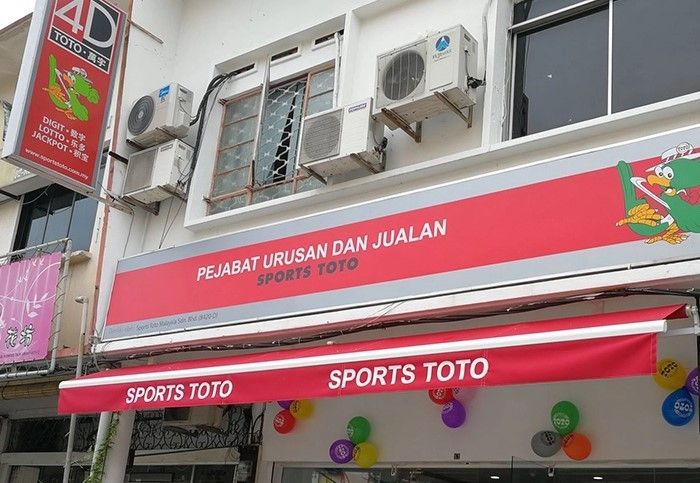
The second is scale. With approximately 680 outlets nationwide and an estimated 43% share of the legal NFO market, Sports Toto has the widest physical distribution network of any licensed operator. Its games include Toto 4D, Toto 4D Jackpot, Toto 4D Zodiac, Toto 5D, Toto 6D, Star Toto 6/50, Power Toto 6/55, and Supreme Toto 6/58.
The licence is not permanent. NFO licences are subject to annual renewal by the government, a structural risk that rating agencies have flagged as a key moderating factor for the business. The licences cover physical outlets in Peninsular Malaysia — not apps or online platforms. Sports Toto and Magnum, unlike Singapore’s licensed operator which went digital in 2016, still sell only at physical counters.
That limitation is the single most important constraint on the business. The illegal market can offer daily draws, mobile access, and 24/7 availability. The legal market cannot.
The Games and the Jackpot That Broke Records
Sports Toto’s product portfolio is built around two pillars: Digit games and Lotto games.
The Digit games — Toto 4D, 4D Jackpot, 4D Zodiac, 5D, and 6D — are the volume drivers. They compete directly with Magnum and Da Ma Cai in the 4D category and generate the bulk of ticket sales.
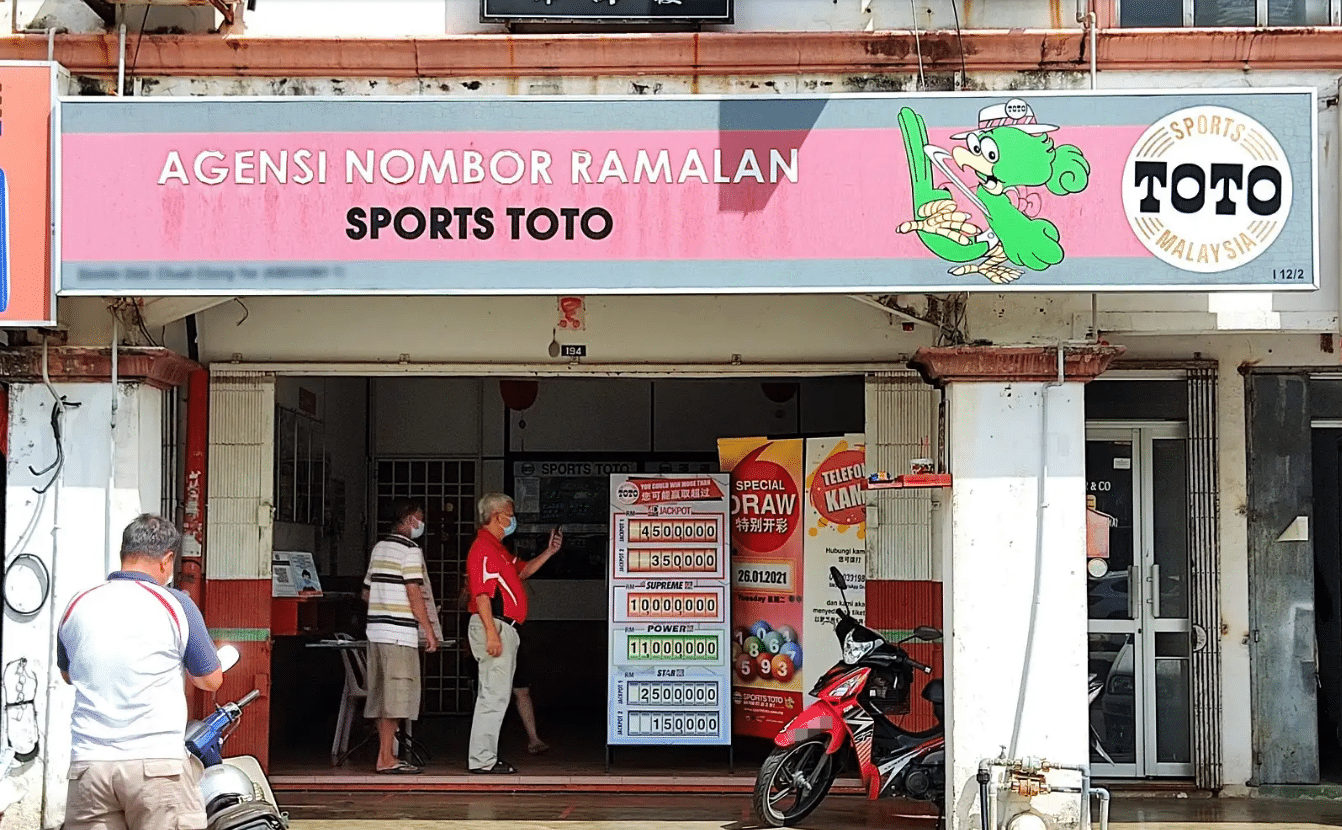
The Lotto games — Star Toto 6/50, Power Toto 6/55, and Supreme Toto 6/58 — are the jackpot engines. They are the differentiator that no other licensed operator can match.
In January 2025, that differentiator delivered the largest jackpot in Malaysian history. The Supreme Toto 6/58 accumulated jackpot reached RM121.7 million, and multiple lucky punters won it on 18 January 2025. The record jackpot contributed to a surge in ticket sales and created a high base effect that the company has been cycling against ever since.
That high base is one reason FY2026 revenue declined. The NFO segment’s revenue slipped 5.3% year-on-year to RM2.9 billion, partly because the prior year included the record jackpot period, and partly because FY2026 had one fewer special draw.
Financials: A Tale of Two Businesses
Sports Toto Berhad is not a pure-play gaming company. The interaction of two very different businesses — a high-margin lottery operation and a cyclical luxury car dealership — shapes its financial results.
For FY2026 (ended 30 June 2026), group revenue was RM6.04 billion, down 6.8% from RM6.48 billion in FY2025. Net profit fell 19.3% to RM188.86 million from RM233.94 million.
The NFO segment — the lottery business — contributed RM2.95 billion in revenue, down from RM3.11 billion. Its EBIT fell 10.8% to RM385.9 million. The H.R. Owen segment contributed RM2.93 billion in revenue but swung to an operating loss of RM3.7 million from a profit of RM33.0 million a year earlier, dragged by challenging economic conditions in the UK, weaker luxury car sales, and higher staff costs.
The fourth quarter of FY2026 told a different story. Net profit surged 55% year-on-year to RM62.5 million, driven by sharply lower direct costs and indirect expenses, and a turnaround in “other” businesses that swung to an EBIT profit of about RM29 million from a RM9 million loss. Revenue for the quarter fell 4.9% to RM1.55 billion, mainly due to one fewer draw and weaker motor dealership performance.
The dividend reflected the board’s confidence in cash generation. Sports Toto declared a fourth interim dividend of 3 sen per share, bringing the total FY2026 payout to 11 sen per share — up from 8 sen in the prior year.
The Kedah Ban: Three Years, One Federal Court Ruling
The most consequential regulatory event of 2026 for Sports Toto was not a change in federal law. It was a state-level ban that was finally struck down.
Since 2023, lottery operators — including Sports Toto — had been unable to open physical outlets in Kedah, despite holding valid federal licences. The Kedah state government, controlled by PAS, had refused to renew business premises licences for NFO outlets, effectively enforcing a state-wide ban through the local licensing process.
Sports Toto and four individuals challenged the decision, seeking to quash the state government’s refusal to renew their business premises licence in Kangar. The case wound through the courts, and on 12 August 2026, the Federal Court unanimously denied the Kedah state government leave to appeal, bringing the legal battle to a close.
The practical impact is modest in revenue terms but significant in principle. RHB Research estimated that resuming Kedah operations could provide a mild 3% uplift to the lottery business, with an unclear timeline at present. The more important signal is that state governments cannot use business licensing to override federal gambling licences — a precedent that reinforces the federal nature of gambling regulation.
Sports Toto’s management has said it is engaging the relevant authorities for approvals to recommence operations in Kedah.
The Real Competitor: An Illegal Market Twice the Size
The most serious threat to Sports Toto is not Magnum, not Da Ma Cai, and not the Kedah state government. It is the illegal NFO market.
By the company’s own assessment, the illegal NFO industry is now approximately twice the size of the legal industry, at RM8 billion to RM9 billion. The illegal market proliferated during the COVID-19 lockdowns of 2020 and 2021, when legal outlets were closed and illegal operators set up apps and gaming websites to capture demand. Ticket sales per draw have never returned to pre-pandemic levels — currently RM16 million to RM17 million per draw, or about 85% of pre-pandemic levels.
The structural disadvantage is stark. Legal NFOs are restricted to physical outlets and a limited number of draws per week. Illegal operators offer daily draws, higher payouts, and 24/7 mobile access. The penalty for operating an illegal lottery, meanwhile, is only RM5,000 to RM10,000 under current law — a cost that is easily absorbed by a profitable syndicate.
Sports Toto has responded by educating customers on the penalties of buying from illegal operators and by working with enforcement authorities. It has also advocated for tele-betting to be permitted for legal NFOs, arguing that the government should enforce strict bans on illegal and online betting operators rather than restricting the legal market.
Whether that advocacy succeeds is a policy question, not a commercial one. The company cannot compete with the illegal market on product features. It can only compete on trust, brand, and the legitimacy of its licence.
Regulatory Record: Clean, but Fighting an Unfair Fight
Sports Toto’s regulatory record is, by the standards of the gaming industry, clean. There have been no publicly reported enforcement actions, licence suspensions, or regulatory fines against STM Lottery’s NFO operation.
The company positions itself as a compliant operator that works closely with Bank Negara Malaysia, the Ministry of Finance, local councils, and district police to ensure adherence to regulations. It operates under the Pool Betting Act 1967 and the Lotteries Act 1952, with its media messages and gaming operations subject to MOF oversight.
That clean record is a competitive asset. In a market where illegal operators are the dominant competitor, the value of a federal licence is precisely that it certifies legitimacy. Sports Toto’s brand depends on that certification.
FAQ
Who owns Sports Toto Malaysia?
Sports Toto Malaysia is the brand of STM Lottery Sdn Bhd, a wholly owned subsidiary of Sports Toto Berhad (KLSE: SPTOTO). Sports Toto Berhad is part of Vincent Tan’s Berjaya Group, which is also a major shareholder in Berjaya Corporation Berhad and Berjaya Assets.
Is Sports Toto the largest lottery operator in Malaysia?
Yes. Sports Toto is the largest number forecast operator in Malaysia, with approximately 43% market share and about 680 outlets nationwide. It also holds the sole licensed Lotto operator status, offering games like Supreme Toto 6/58 and Power Toto 6/55.
What was Sports Toto’s FY2026 net profit?
Sports Toto’s FY2026 net profit was RM188.86 million, down 19.3% from RM233.94 million in FY2025. Revenue declined 6.8% to RM6.04 billion.
What happened with the Kedah lottery ban?
Since 2023, the Kedah state government had refused to renew business premises licences for NFO outlets, preventing Sports Toto from operating there despite holding federal licences. On 12 August 2026, the Federal Court denied Kedah leave to appeal, clearing the way for operations to resume.
What is the biggest threat to Sports Toto’s business?
The illegal NFO market, which is estimated to be twice the size of the legal industry at RM8 billion to RM9 billion. Illegal operators offer daily draws, mobile access, and higher payouts, while legal operators are restricted to physical outlets.
Does Sports Toto pay dividends?
Yes. Sports Toto declared a total dividend of 11 sen per share for FY2026, up from 8 sen in FY2025. The fourth interim dividend of 3 sen was payable on 16 October 2026.
Sources
- The Edge Malaysia — “Sports Toto raises dividend to three sen per share as 4Q earnings surges 55%,” 17 August 2026. theedgemalaysia.com.
- The Star — “Kedah ops resumption positive for Sports Toto,” 19 August 2026. thestar.com.my.
- The Star — “Sports Toto 4Q earnings surge 55% to RM62.5mil,” 18 August 2026. thestar.com.my.
- StockAnalysis.com — Sports Toto Berhad (KLSE:SPTOTO) Financials Overview, September 2026.
- Asia Pacific Lottery Association — “STM Lottery Sdn Bhd,” 21 February 2022. asiapacific-lotteries.com.
- Wikipedia — “Sports Toto,” accessed November 2026.
- TA Securities — Sports Toto Berhad results review, FY2026. klse.i3investor.com.
- AmInvest Research — “Sports Toto: Growing threat of illegal NFOs,” 5 July 2023. klse.i3investor.com.
- Berjaya Corporation Berhad — Sports Toto Berhad corporate profile and management analysis. berjaya.com.