Most Malaysians have heard of the Common Gaming Houses Act 1953. Very few have read it. That is a problem, because the Act’s reach is wider than almost anyone assumes — wider, in some respects, than the people enforcing it sometimes realise.
The Act was enacted as Federal Ordinance No. 26 of 1953, revised in 1983 as Act 289, and last amended by Act A1096 in 2001. Its long title is modest: “An Act relating to the suppression of common gaming houses, public gaming, and public lotteries”. Its effect is not modest. It is the statute under which police raid online betting call centres, charge influencers for promoting gambling sites, and prosecute individuals for playing poker in a condominium.
This is a clause-by-clause explanation of what the Act actually says — not what people think it says.
Sections 1 and 2: The Territory and the Definitions
Section 1 gives the Act its short title and states that it applies to Peninsular Malaysia only. The commencement provision extends it to Sabah and Sarawak from 15 April 1992, but no one has cleanly reconciled the territorial application clause with that extension in the reprinted text. In practice, Sabah and Sarawak have their own gambling ordinances, and authorities apply the CGHA principally in the peninsula.
Section 2 is where the Act’s reach is actually determined, and it is drafted with unusual breadth.
“Gaming” is defined as “the playing of any game of chance or of mixed chance and skill for money or money’s worth,” and it expressly includes “the playing or operation of any gaming machine”. The phrase “mixed chance and skill” is doing a lot of work. It captures poker, mahjong, and card games that players often describe as skill-based. If money or money’s worth is at stake, the skill element does not take the activity outside the definition.
The Act defines “gaming machine” broadly. It includes any mechanical, electrical, or electronic machine or device. It also includes any computer program that runs on such a machine or device. A person must design or adapt the machine or device for playing a game of chance or mixed chance and skill. It must also be able to pay out winnings. Including “computer program” lets the Act reach digital gambling. That mattered little in 1953. It matters enormously now.

Section 3 and 3A: Nuisance and the Prosecution’s Shortcut
Section 3 declares every common gaming house to be “a common and public nuisance contrary to law”. That declaration has practical consequences beyond rhetoric. It supports abatement orders, closure powers, and the demolition provisions in Section 21.
Section 3A is a procedural provision that litigants often overlook but that matters enormously in court. It provides that where the prosecution charges a person under Section 6 or Section 7, it need only state that it found the person gaming, without specifying the game the person played. It also allows the prosecution to prove merely that the game was a bankers’ game or one listed in the Second Schedule, without proving the specific game.
In plain terms: the prosecution does not have to reconstruct the rules of the game or call an expert on mahjong variants. It has to prove that gaming took place.
Section 4: The Operator’s Dragnet
Section 4 is the central operator provision, and it is drafted to capture almost everyone in the chain of supply.
4(1)(a) covers the owner or occupier who “keeps or uses a place as a common gaming house.” Section 4(1)(b) covers an owner or occupier who “permits” another person to keep or use the place as a common gaming house. Section 4(1)(c) covers anyone who “has the care or management of or in any manner assists in the management of” such a place. The phrase “in any manner assists” is deliberately wide. It captures the person who runs the operation. Captures the person who books the room. It captures the person who handles the money. It arguably captures the person who advertises it.
Section 4(1)(g) creates a separate offence. It covers announcing or publishing that someone keeps or uses a place as a common gaming house. It also covers inviting or soliciting anyone to breach Section 6 or Section 9. Authorities use this provision against social media influencers who promote gambling sites. The promotion itself is the offence, not the gambling.
Section 4(1)(h) reaches competitions that newspapers, periodicals, or a trade or business run, where the promoter offers prizes for forecasting the result of a future or unknown past event, or where success does not depend “to a substantial degree upon the exercise of skill”. This is the provision that catches disguised betting competitions and prediction contests run by businesses.
Section 4A: The Lottery Provision With the Heaviest Fine
Section 4A deals with public lotteries, and its penalty is the heaviest fine in the Act.
It criminalises assisting in the carrying on of a public lottery; receiving money for a chance in a public lottery. Criminalises selling, offering, giving, delivering, or collecting lottery tickets; drawing or declaring the winner or winning number. It criminalises writing, printing, or publishing lottery tickets, prize lists, or results. It also criminalises publishing “any announcement or riddle relating to a public lottery.”
The penalty is a fine of not less than RM20,000 and not more than RM200,000, and imprisonment for up to five years. The word “shall” in “shall also be punished with imprisonment” means the jail term is not optional — it is part of the sentence.
That “riddle” provision is worth pausing on. It captures the coded number puzzles that appear in some newspapers and online forums, where the “riddle” is a disguised prompt for a 4D number. The Act anticipated that evasion in 1953.

Section 4B: The Machine Provision
Section 4B criminalises dealing in gaming machines in any form — importing, manufacturing, assembling, supplying, selling, assigning, charging, leasing, hiring, servicing, repairing, adapting, or modifying a gaming machine or any part or replacement part.
The penalty is a fine of not less than RM10,000 and not more than RM100,000 “for every gaming machine seized,” plus imprisonment for up to five years. The per-machine structure is what makes this provision devastating for operators. A call centre with fifty devices is not facing one fine. It is facing fifty.
This is also the provision that captures online gambling infrastructure. A laptop or phone used to operate a gambling platform can be a “gaming machine” under Section 2, and “dealing” includes adapting or modifying it.
Section 5: Following the Money
Section 5 criminalises advancing or furnishing money for the purpose of establishing or conducting a common gaming house or public lottery, or profiting from the establishment or conduct of such a business.
The penalty is RM5,000 to RM50,000 and up to three years’ jail. This is the provision that reaches financiers, investors, and anyone who takes a share of the proceeds without being physically present at the operation. It is also the conceptual bridge to the Anti-Money Laundering Act, which is routinely charged alongside the CGHA in syndicate cases.
Sections 6 and 7: The Player’s Provisions
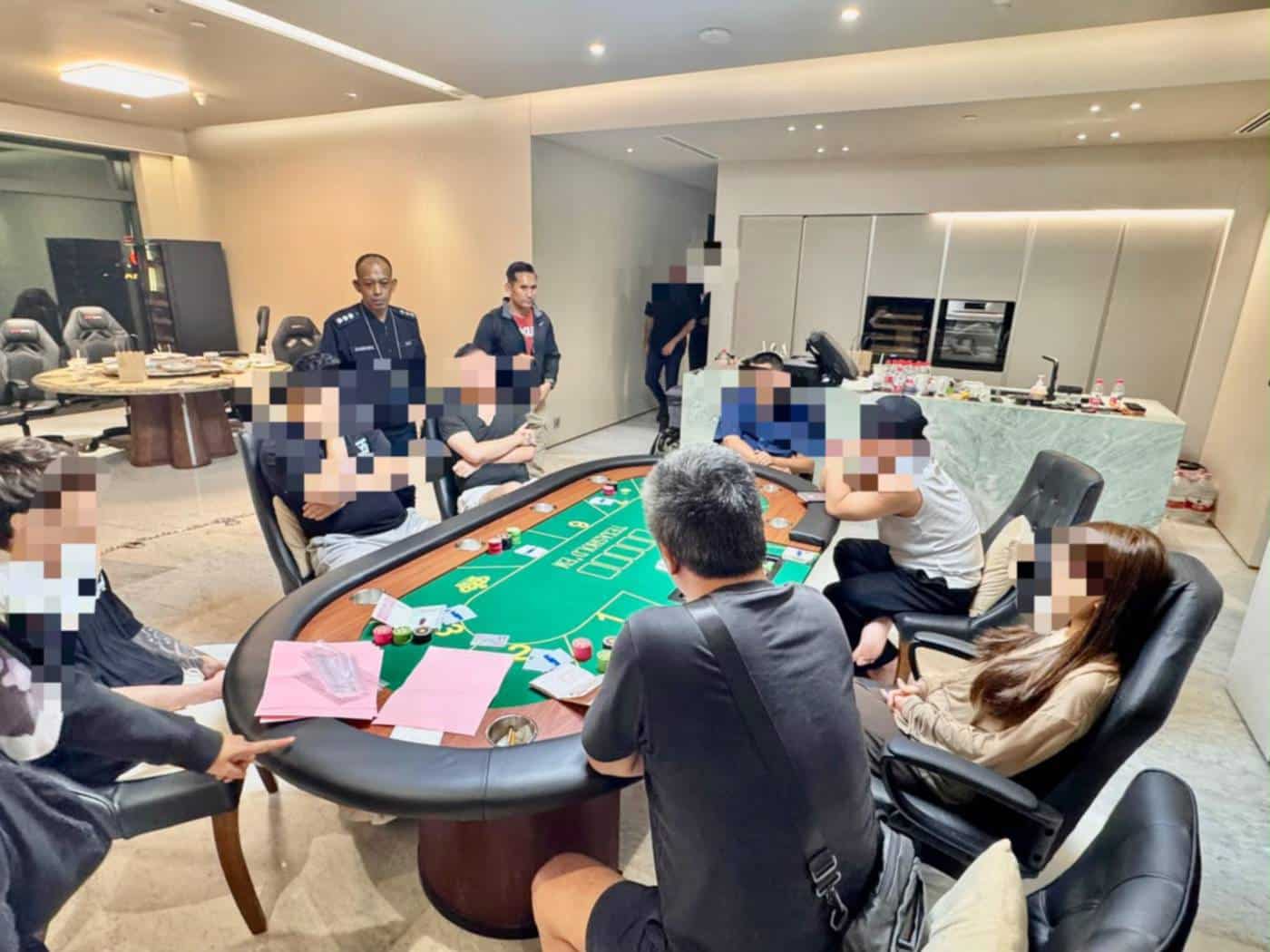
Section 6(1) is the most commonly charged provision in the Act. Any person who “games in a common gaming house” commits an offence and is liable on conviction to a fine not exceeding RM5,000, imprisonment for up to six months, or both.
Section 6(2) is the presumption that does most of the work in practice. A person found in a common gaming house, or found escaping from one when it is entered under the Act, is presumed “until the contrary is proved” to be or to have been gaming there. Presence is enough to require an explanation. The burden shifts to the defendant.
Section 7 deals with gaming in a public place. It authorises a police officer to arrest without warrant any person found gaming in a public place and to seize instruments and appliances. The penalty is a fine up to RM5,000, imprisonment up to six months, or both, and the instruments are liable to forfeiture. Section 7(3) presumes that where money or valuables are used in playing a game in a public place, the players were gaming.
“Public place” is defined to include public streets, roadways, lanes, open spaces, and “any place to which the public has or may have access”. A corridor, a parking lot, or a stairwell can qualify.
Sections 8 and 9: Promotion and Ticket Buying
Section 8 targets anyone who instigates, promotes, or intentionally facilitates an offence under Section 7 — gaming in public. The penalty is RM20,000 to RM200,000 and up to five years’ jail. Section 8(2) creates presumptions against persons who erect or control structures where public gaming occurs, who bring gaming instruments to such a place, or who keep watch to warn of detection. The lookout is presumed to have promoted the offence.
Section 9 criminalises paying or depositing money with a person concerned in the business of a common gaming house as a stake, or buying a lottery ticket. The penalty is a fine up to RM5,000, imprisonment up to six months, or both. The buyer of an illegal lottery ticket is not a bystander in the eyes of the Act. They are a participant.
Section 27A: The Only Door In
Section 27A is the Act’s licensing provision, and it is the reason the rest of the statute matters.
It empowers the Minister of Finance, “in his discretion,” to license a company registered under the Companies Act 1965 — expressly excluding a foreign company — to promote and organise gaming, subject to specified games, premises, fees, duties, and conditions, for a period not exceeding three months at a time. The licence can be renewed for further three-month periods, and the Minister can amend, add to, or delete conditions on renewal. The Minister can also revoke the licence at any time.
Contravention of a licence condition carries a fine up to RM50,000, imprisonment up to seven years, or both.
Three features of Section 27A define the entire legal market. First, the power is discretionary — there is no entitlement to a licence. Second, the licence is temporary — three months at a time, renewable, revocable. Third, it is limited to locally incorporated companies, which is why every licensed operator in Malaysia is a Malaysian entity, even when its parent is foreign.
That quarterly renewal cycle is not a technicality. It is the structural leash on the entire licensed gambling industry.
What the Act Does Not Say
The Act was last amended in 2001. It contains no reference to the internet, to online platforms, to e-wallets, or to cryptocurrency. Its territorial reach is Peninsular Malaysia. Its definitions were written for physical premises and physical machines.
That gap had three consequences. First, the Court of Appeal had to confirm in 2023 that online gambling falls under the Act at all. Second, the 2022 High Court decision in Public Prosecutor v Multi Electrical Supply & Services held that Section 4B could not be stretched to cover online gambling offences as the prosecution had attempted. Section 4B is the gaming machine provision. Third, the government is now drafting a separate anti-online gambling statute. It is not relying on a 1953 ordinance to regulate a 2026 market.
The Act is not obsolete. Authorities actively use it every week. But they are asking it to do something they never designed it to do — and the strain shows in every prosecution that has to argue about whether a laptop is a gaming machine.
FAQ
What is the Common Gaming Houses Act 1953?
It is the primary Malaysian statute criminalising unlicensed gambling in Peninsular Malaysia. It creates offences for keeping a common gaming house, assisting a public lottery, dealing in gaming machines, financing gambling, gaming in a common gaming house, gaming in public, promoting public gaming, and buying lottery tickets.
What is the penalty under Section 6(1) of the Common Gaming Houses Act?
A fine not exceeding RM5,000, imprisonment for up to six months, or both. Section 6(2) presumes that anyone found in a common gaming house, or found escaping from one during a raid, was gaming there unless they prove otherwise.
What is the penalty for operating a common gaming house under Section 4?
A fine of RM5,000 to RM50,000, imprisonment for up to three years, and an additional fine of RM5,000 to RM50,000 for every gaming machine seized.
What is the heaviest penalty in the Act?
Section 4A, which covers assisting in a public lottery, carries a fine of RM20,000 to RM200,000 and imprisonment for up to five years. Section 8, which covers promoting public gaming, carries the same penalty.
Does the Act apply to online gambling?
The Act contains no specific online gambling provisions, but the Court of Appeal confirmed in 2023 that online gambling falls under its scope. The definition of “gaming machine” includes computer programs, which is the main hook for digital enforcement.
What does Section 27A allow?
Section 27A empowers the Minister of Finance to license a locally incorporated company to promote and organise gaming, for periods not exceeding three months, subject to conditions, fees, and duties. The licence is discretionary and revocable at any time.
Sources
- Common Gaming Houses Act 1953 (Act 289) — Official reprinted text, Laws of Malaysia, Attorney General’s Chambers. Sections 1, 2, 3, 3A, 4, 4A, 4B, 5, 6, 7, 8, 9, 15–20A, 27A. lom.agc.gov.my.
- Common Gaming Houses Act 1953 — Consolidated text, mylaw.my. Sections 2, 4, 6, 27A.
- Low & Partners — “Section 6(1) of the Common Gaming Houses Act 1953: Penalty provisions and legal commentary.” lowpartners.com.
- WJNT — “Winning Customers Without Breaking the Law: A Basic Guide to Promotions in Malaysia,” July 2026. Section 4(1)(h) analysis.
- LawPlayer — Common Gaming Houses Act 1953, Act 289, consolidated version, September 2026.
- Borneo Post Online — Reports on Sections 4B(a) and 4(1)(c) charges, 2025–2026.
- New Straits Times / The Star — Reports on Sections 4(1)(c) and 4(1)(g) prosecutions, 2026.