
Mastering official baccarat rules reveals why Punto Banco remains one of the simplest yet most mathematically transparent table games in global casinos. In fact, unlike blackjack or poker where players make tactical drawing decisions mid-round, modern casino baccarat follows completely automated dealing procedures from start to finish. Consequently, learning how to play baccarat focuses entirely on understanding card values, grasping the fixed third-card drawing matrix, and comparing baccarat odds across Banker, Player, and Tie.
Furthermore, knowing how the dealer resolves every hand removes any mystery from fast-paced live and digital tables. Therefore, this Pillar guide explains baccarat rules, covering the core game flow, detailing mandatory third-card rules, reviewing payout settlements, and analysing exact mathematical probabilities.
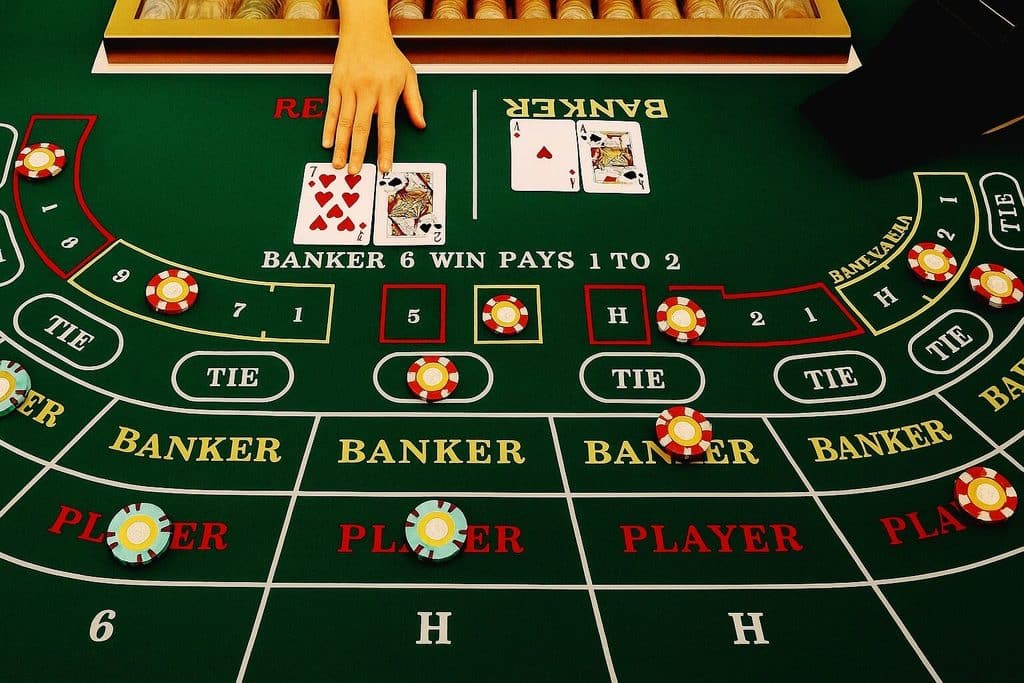
Step-by-Step Baccarat Game Flow and Card Values
To begin with, baccarat rules centre on a straightforward race toward 9 points between two table positions: Player (Punto) and Banker (Banco). Crucially, the names “Player” and “Banker” represent two abstract hands on the felt rather than the guest versus the dealer. Therefore, you can freely back either side—or back a Tie—before the dealer slides cards from a 6-deck or 8-deck shoe.
Card Point Values and the Modulo-10 Total
First, baccarat assigns fixed numerical point values to every rank while ignoring suits (spades, hearts, diamonds, clubs):
- Aces: Count strictly as 1 point.
- Cards 2 through 9: Count at their printed face value.
- 10s, Jacks, Queens, and Kings: Count as 0 points (zero).
Moreover, hand totals never bust over 9 because baccarat drops the tens digit whenever a sum reaches 10 or higher. For example, 7 + 8 = 15, so the hand holds 5 points; similarly, 6 + 4 = 10, leaving 0 points (Baccarat). Thus, 9 stands as the highest possible hand total.
Placing Wagers on Banker, Player, or Tie
Next, after all seated guests place chips inside the Banker, Player, or Tie boxes, the dealer deals two cards to Player and two cards to Banker alternatingly. Subsequently, the dealer announces both two-card totals aloud and automatically applies the mandatory third-card tableau.

Baccarat Third-Card Drawing Rules (Tableau)
Moreover, the third-card tableau governs every draw automatically, meaning neither the player nor the dealer exercises personal discretion. Specifically, the Player hand always acts first, and the Banker hand reacts according to both its own total and the Player’s third card.
Natural 8 or 9 and Player Hand Drawing Rules
First, if either Player or Banker holds an initial two-card total of 8 or 9, officials call that hand a Natural. Consequently, both hands stand immediately, the round ends, and the higher total wins (a 9 beats an 8, while matching Naturals tie). Otherwise, if neither side holds a Natural, the Player hand obeys two simple rules:
- Player totals 0 to 5: Player must draw a third card.
- Player totals 6 or 7: Player must stand with two cards.
Mandatory Banker Third-Card Drawing Matrix
Meanwhile, if the Player stood on 6 or 7, the Banker follows the exact same rule: hit on 0–5 and stand on 6–7. However, if the Player drew a third card, the Banker consults a fixed conditional table under baccarat rules:
- Banker totals 0, 1, or 2: Banker always draws a third card.
- Banker totals 3: Banker draws unless Player’s third card is an 8.
- Banker totals 4: Banker draws only if Player’s third card is 2, 3, 4, 5, 6, or 7.
- Banker totals 5: Banker draws only if Player’s third card is 4, 5, 6, or 7.
- Banker totals 6: Banker draws only if Player’s third card is 6 or 7.
- Banker totals 7: Banker always stands.
Consequently, every round resolves cleanly with at most three cards per hand.

Round Outcomes, Payouts, and the 5% Commission
Subsequently, once both sides complete any mandatory draws, the dealer compares the final scores and settles chips immediately. Specifically, knowing how baccarat rules handle commissions and ties prevents payout surprises at the table.
Banker, Player, and Tie Payout Structures
First, a winning Player bet pays 1:1 (even money) with zero commission—for instance, a 100-unit stake returns 200 units (100 units profit). Second, a winning Banker bet also pays 1:1, minus a standard 5% house commission (100 units stake returns 195 units, or 95 units net profit). Third, a winning Tie bet typically pays 8:1 (occasionally 9:1), returning 900 units on a 100-unit stake. Crucially, if a round ends in a Tie, all standing Player and Banker wagers result in a Push and remain untouched.
No-Commission Baccarat and the Super 6 Rule
Additionally, many modern Asian and European rooms feature No-Commission Baccarat (Nepal / Super 6). In this variant, winning Banker bets pay full 1:1 on every winning total except 6, where a winning Banker 6 pays 1:2 (half profit). However, this adjustment actually lifts the Banker house edge slightly from 1.06% to 1.46%.
Baccarat Odds, House Edge, and Mathematical Reality
In addition, examining exact baccarat odds highlights why experienced table analysts treat the three main bets very differently. Because the Banker acts second with full visibility of the Player’s third card, Banker wins marginally more often.
Comparing House Edge Across Banker, Player, and Tie
Specifically, across an 8-deck shoe (including ties):
- Banker Win Rate: 45.86% (excluding ties: 50.68%), producing a 1.06% house edge.
- Player Win Rate: 44.62% (excluding ties: 49.32%), producing a 1.24% house edge.
- Tie Rate: 9.52%, producing a steep 14.36% house edge at 8:1 payouts (or 4.84% at 9:1).
Therefore, Banker and Player rank among the lowest-edge bets on any casino floor, whereas Tie and optional Pair side bets carry significantly higher mathematical costs. Furthermore, scoreboards tracking past “Big Road” streaks hold zero predictive power because each shoe hand remains statistically independent. Always manage session limits responsibly and participate solely within regulated jurisdictions.

Frequently Asked Questions About Baccarat Rules
What is the main objective under standard baccarat rules?
The primary objective under baccarat rules is to predict whether the Player hand or Banker hand finishes closer to 9 points, or whether both hands finish in a Tie.
Why does a winning Banker bet pay a 5% commission?
Because the automated drawing rules give the Banker hand a slight positional advantage (50.68% of decisive hands), casinos charge a 5% commission to preserve a fair 1.06% house edge.
Which baccarat wager carries the lowest house edge?
The Banker wager carries the lowest house edge at 1.06%, followed closely by Player at 1.24%, while Tie at 8:1 carries a 14.36% house edge.