Understanding the mathematical hierarchy and card evaluation standards of poker hands enables cardroom enthusiasts to make sharp tactical decisions at the tables. In fact, standard poker variants like Texas Hold’em and Omaha rely on a universal ten-tier ranking system that governs every showdown from local card clubs to World Series championship events. Consequently, studying how mathematical frequencies determine hand strength separates disciplined strategists from novice players.
Furthermore, transparent card knowledge prevents costly misreads during high-pressure showdowns. Therefore, this comprehensive visual guide explores poker hands, ranking all ten combinations from Royal Flush down to High Card, presenting mathematical probabilities, outlining tie-breaker kicker rules, and analyzing concrete game scenarios.
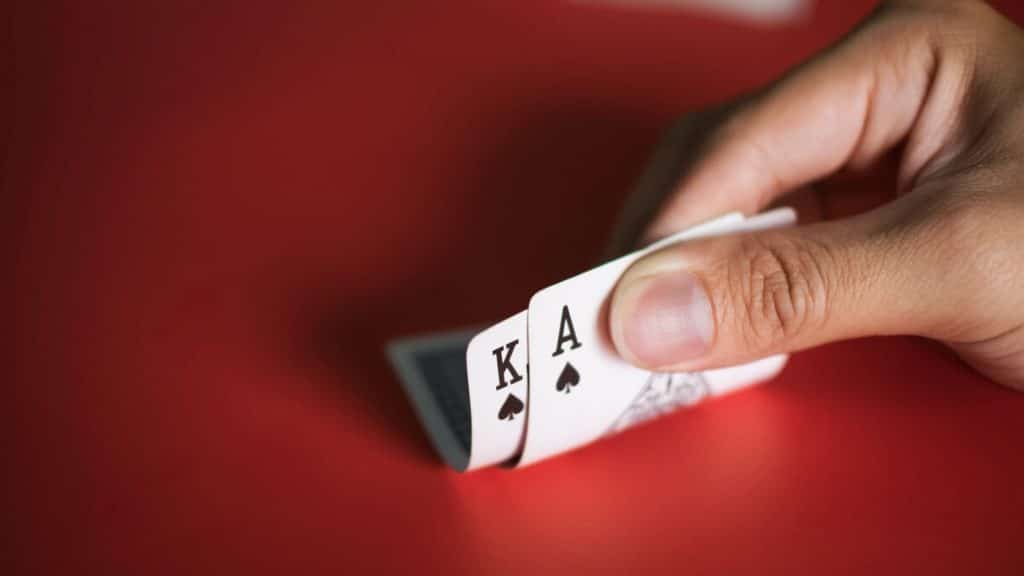
Complete Hierarchy of Poker Hands from Royal Flush to High Card
To begin with, standard poker uses a 52-card deck without wild cards, creating exactly 2,598,960 possible five-card combinations. Specifically, the rarity of each combination directly dictates its rank, meaning rarer card holdings outrank more common hands every time.
The Five Unbeatable Premium Hands Explained
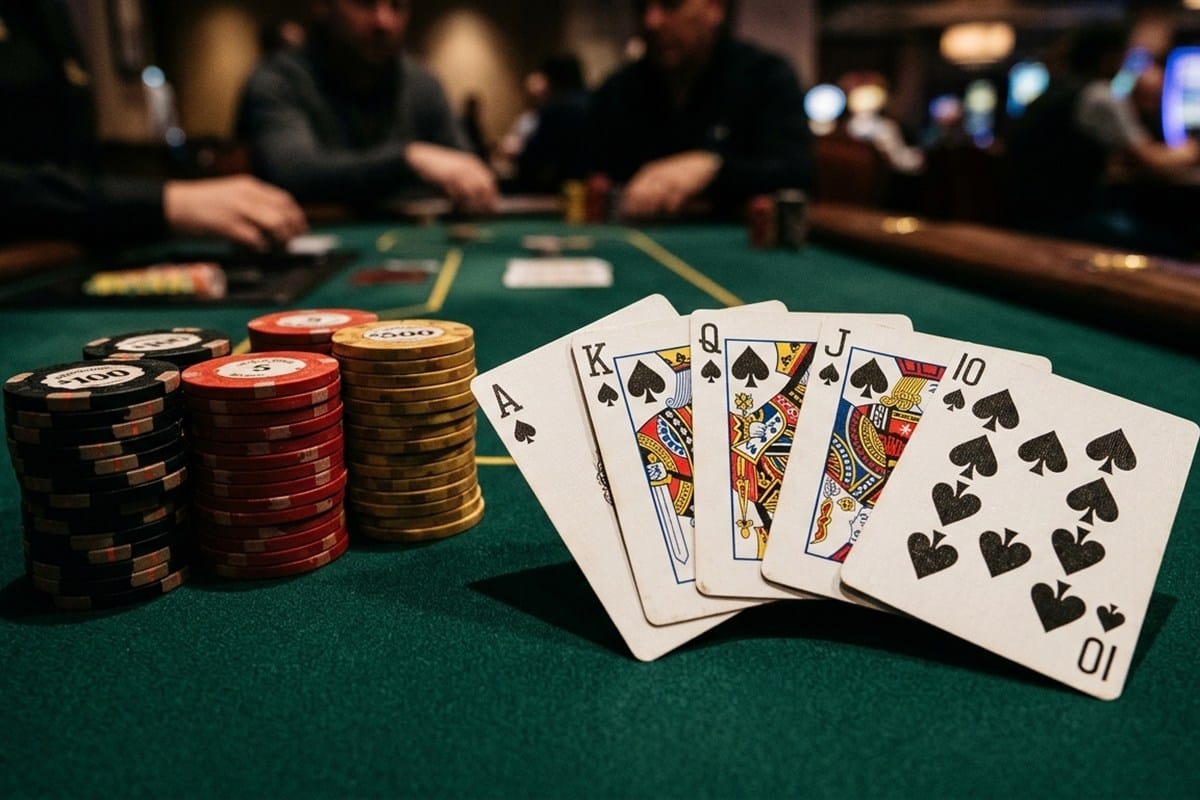
First, the undisputed pinnacle of all card combinations is the Royal Flush, which consists of an Ace, King, Queen, Jack, and Ten of the exact same suit. Because only 4 distinct Royal Flushes exist in a 52-card deck, the mathematical probability of hitting one is an astonishing 1 in 649,740 (0.000154%).
Second, the Straight Flush ranks just below the Royal Flush, comprising five consecutive cards of identical suit, such as 9-8-7-6-5 of hearts. There are 36 possible Straight Flushes, carrying odds of 1 in 72,192.
Third, Four of a Kind (Quads) features four cards of identical numerical rank plus an unrelated fifth kicker card, such as four Aces with a Queen. This devastating monster holding occurs 624 times, reflecting a probability of 1 in 4,165.
Fourth, a Full House (Boat) combines three matching cards of one rank with a matching pair of another rank, such as K-K-K-7-7. Occurring 3,744 times, it commands odds of 1 in 694.
Fifth, a Flush consists of any five cards of the same suit that do not form a sequence, such as A-J-8-5-2 of spades. There are 5,108 Flush combinations, appearing roughly 1 in 508 times.
Mid-Tier and Starting Hands from Straight to High Card
Sixth, a Straight contains five consecutive cards of mixed suits, such as 8-7-6-5-4. It occurs 10,200 times, carrying mathematical odds of 1 in 254.8.
Seventh, Three of a Kind (Set or Trips) features three cards of equal rank alongside two unmatched kickers, such as 9-9-9-K-4. This combination occurs 54,912 times, with a probability of 1 in 47.3.
Eighth, Two Pair consists of two separate pairs of matching rank plus one kicker, such as J-J-4-4-A. Because it appears 123,552 times, players encounter this hand approximately 1 in 21 times.
Ninth, One Pair contains two cards of matching rank with three unmatched kickers, such as 10-10-K-8-3. With 1,098,240 combinations, players hold a pair in 42.26% of all random five-card hands.
Tenth, High Card occurs when a five-card holding fails to make any pair, straight, or flush. Ranked purely by its highest single card, it accounts for 1,302,540 combinations, occurring in 50.12% of random deals.
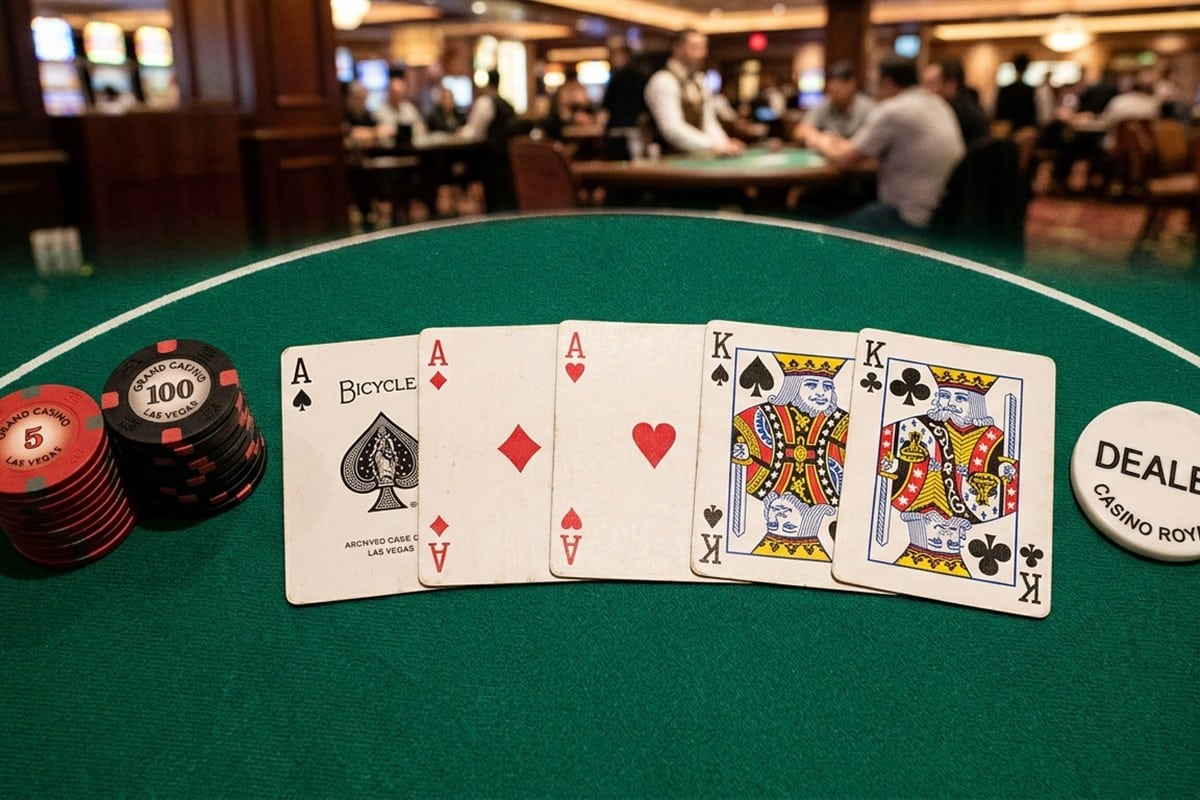
Poker Hand Rankings and Hierarchy Breakdown
Moreover, understanding the exact hierarchy chart allows players to identify winning showdown hands immediately without hesitation. Specifically, comparing the mathematical distribution reinforces why certain holdings command enormous table value.
Standard 10-Tier Ranking Table and Mathematical Frequencies
To illustrate clearly, here is the universal hierarchy governing standard poker hands ranked:
- 1. Royal Flush: A-K-Q-J-10 of same suit (Probability: 0.00015%)
- 2. Straight Flush: Five sequential cards of same suit (Probability: 0.00139%)
- 3. Four of a Kind: Four cards of equal numerical rank (Probability: 0.02401%)
- 4. Full House: Three of a kind plus a pair (Probability: 0.1441%)
- 5. Flush: Five non-consequential cards of identical suit (Probability: 0.1965%)
- 6. Straight: Five sequential cards of mixed suits (Probability: 0.3925%)
- 7. Three of a Kind: Three cards of equal rank (Probability: 2.1128%)
- 8. Two Pair: Two distinct pairs plus one side card (Probability: 4.7539%)
- 9. One Pair: Two cards of identical rank (Probability: 42.2569%)
- 10. High Card: No pair, evaluated by highest single card (Probability: 50.1177%)
Therefore, memorizing this ten-tier ladder provides the structural foundation for all tactical gameplay.
Tie-Breakers, Kickers and Card Suit Rules
Meanwhile, when two or more players present identical hand categories at showdown, specific tie-breaking rules determine the victor. In standard poker, all four card suits hold equal rank, meaning a flush in spades never outranks a flush in hearts. Instead, the rank of the cards themselves decides the pot.
Furthermore, when players hold identical pairs or trips, the highest unmatched side card (the kicker) determines the winner. For example, if Player A holds A-A-K-9-4 and Player B holds A-A-Q-J-8, Player A wins because their King kicker outranks Player B’s Queen. Consequently, paying close attention to kicker strength prevents costly showdown errors.
Concrete Game Scenarios and Winning Combinations in Texas Hold’em
Subsequently, analyzing real game scenarios illustrates how five-card hands assemble from hole cards and community board textures in Texas Hold’em. In particular, each player selects the best five cards out of seven available cards.
Scenario Breakdown – Two Pair vs Flush Showdown
Suppose the community board shows K♠ – 10♠ – 4♠ – 8♦ – 2♣:
- Player 1 holds K♦ – 10♦, making Two Pair (Kings and Tens) with an 8 kicker.
- Player 2 holds A♠ – 3♠, completing an Ace-High Flush in Spades (A♠ – K♠ – 10♠ – 4♠ – 3♠).
In this showdown, Player 2 wins the entire pot effortlessly because a Flush cleanly outranks Two Pair on the official hierarchy of poker hands.
Navigating Split Pots and Shared Community Cards
Additionally, situations frequently arise where the five best cards reside entirely on the board or both competitors make identical five-card holdings. For instance, if the board displays A♣ – K♦ – Q♠ – J♥ – 10♣ (a broadway straight), and neither player holds a card that improves the hand, the dealer declares a split pot. As a result, the dealer divides the accumulated pot equally between all surviving players.
House Realities, Variance and Bankroll Risk Management
In addition, recognizing statistical variance prevents players from tilting during bad beats. Crucially, holding a premium hand does not guarantee victory on every single street, as opponents can draw out on later betting rounds.
Variance and Independent Hand Distributions
Moreover, card distributions follow rigorous mathematical probability across large sample sizes, but short-term sessions produce high variance swings. Therefore, disciplined cardroom players never gamble with money they cannot afford to lose. Furthermore, establishing clear session stop-loss limits protects bankroll longevity against negative variance streaks.
Responsible Play Standards
Finally, always treat poker as a game of skill and entertainment rather than a reliable source of primary income. Maintaining emotional composure and respecting responsible gaming standards ensures that your table experience remains engaging and intellectually rewarding.

Frequently Asked Questions About Poker Hands
What is the highest ranking among all poker hands?
The Royal Flush (Ace, King, Queen, Jack, and Ten of the identical suit) is the highest and most powerful hand in poker.
Does a flush beat a straight in standard poker?
Yes, a Flush beats a Straight because five suited cards occur less frequently (0.196%) than five sequential cards (0.393%).
How do kickers break ties between identical poker combinations?
When players hold the same pair or three of a kind, the dealer compares the highest unmatched side card (the kicker) to determine the winner.