
Most beginner betting guides start with a history lesson or a glossary. This one starts with the only thing that matters: odds are not a prediction of what will happen. They are a price for what might happen.
Once you understand that odds are a price, everything else follows. The format is just a language. The calculation is just arithmetic. The margin is just the bookmaker’s fee. And the goal — for the bettor — is to find prices that are wrong.
The Three Formats, and Why They Exist
Bookmakers use three odds formats, and the one you see depends on where you are and which platform you use. Decimal odds are standard in Europe and on most international betting sites, including the offshore platforms that accept Malaysian players. Fractional odds are traditional in the UK. American odds are standard in the United States.
They all express the same thing. The format is a matter of convention, not mathematics.
Decimal odds show the total return per unit staked, including the stake itself. If the decimal odds are 2.50 and you stake RM100, your total return is RM250 — your RM100 stake plus RM150 profit. Decimal odds are the simplest format for calculating returns because the formula is always the same: stake × decimal odds = total return.
Fractional odds show profit relative to stake. Odds of 3/1 mean you win RM3 in profit for every RM1 staked. Odds of 1/3 mean you win RM1 in profit for every RM3 staked. The total return is the profit plus the stake. Fractional odds are less intuitive for quick calculation, but they are historically embedded in UK betting culture.
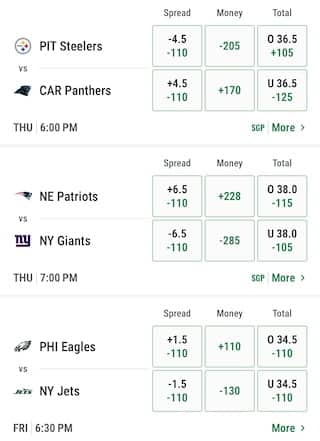
American odds use a plus or minus sign. Positive odds show how much profit you make on a $100 stake. +150 means a $100 stake returns $150 in profit, for a total of $250. Negative odds show how much you must stake to win $100 in profit. -200 means you must stake $200 to win $100, for a total return of $300.
The conversion between formats is mechanical, and most platforms let you switch with a single tap. But understanding the underlying logic is useful, because the format shapes how people perceive value. A 1/3 fractional price feels different from a 1.33 decimal price, even though they are identical.
Implied Probability: The Number Behind the Odds
The most useful skill for a beginner is converting odds into implied probability. This tells you what percentage chance the bookmaker is pricing into the outcome.
For decimal odds, the formula is simple: implied probability = 1 ÷ decimal odds. Decimal odds of 2.00 imply a 50% chance. Decimal odds of 4.00 imply a 25% chance. Decimal odds of 1.50 imply a 66.67% chance.
For fractional odds, the formula is: implied probability = denominator ÷ (denominator + numerator). Odds of 3/1 imply 1 ÷ (1 + 3) = 25%. Odds of 1/3 imply 3 ÷ (3 + 1) = 75%.
For American odds, the formula depends on the sign. Positive odds of +X imply 100 ÷ (X + 100). Negative odds of -X imply X ÷ (X + 100).
Implied probability is not the true probability. It is the bookmaker’s assessment plus their margin. If the implied probability of all outcomes in a market adds up to more than 100%, the excess is the bookmaker’s margin — their built-in profit.
The Margin: Why the Bookmaker Always Wins (Over Time)
A bookmaker does not set odds to predict outcomes. It sets odds to balance its book and guarantee a profit regardless of the result.
The mechanism is the overround, also called the margin. In a simple two-outcome market, if the true probability of each outcome is 50%, fair odds would be 2.00 on both sides. But a bookmaker might offer 1.90 on both sides. The implied probability of each outcome is then 52.63%, and the total implied probability is 105.26%. The extra 5.26% is the bookmaker’s margin.
This is why betting is not a zero-sum game in the short term. Every bet you place carries a built-in cost. To win over time, you must find outcomes where your assessment of the true probability is more accurate than the bookmaker’s — by a margin larger than the overround.
That is difficult. It is not impossible. But it is the reason most bettors lose over time, and it is the first concept a beginner should understand before placing a single bet.

Asian Handicap: Removing the Draw
The Asian handicap is the most important betting market in Asian football, and it is the market most Malaysian beginners encounter without understanding it.
A standard football match has three outcomes: home win, draw, away win. The Asian handicap removes the draw by applying a virtual goal advantage or disadvantage to one team. The favourite is given a negative handicap (e.g., -1), meaning they must win by more than that margin. The underdog is given a positive handicap (e.g., +1), meaning they start with a virtual head start.
The market then has two outcomes instead of three. The draw either does not exist as a separate outcome, or it returns the stake.
The lines work on a scale of whole goals, half goals, and quarter goals. A 0 handicap (level ball) is “draw no bet”: a win pays, a draw returns the stake, a loss loses. A -0.5/+0.5 line means the favourite must win by any margin; there is no stake return. A -1/+1 line means the favourite must win by two or more goals; a one-goal win returns the stake. A -1.5/+1.5 line means the favourite must win by two or more goals; there is no stake return.
Quarter-goal lines end in .25 or .75 and split the stake across two adjacent lines. A -0.75 handicap splits the stake between -0.5 and -1. If the favourite wins by two or more goals, both halves win. If they win by exactly one goal, the -0.5 half wins and the -1 half returns the stake. A draw or defeat loses both halves.
The Asian handicap is popular because it eliminates the draw, reduces the bookmaker’s overround compared with the 1X2 market, and creates a two-outcome structure that rewards research on team form and match context.
A Worked Example: From Odds to Payout
Suppose a bookmaker offers decimal odds of 2.50 on a home win. You stake RM100.
- Total return if the bet wins: RM100 × 2.50 = RM250.
- Profit: RM250 − RM100 = RM150.
- Implied probability: 1 ÷ 2.50 = 40%.
If the bookmaker’s true assessment is that the home team has a 45% chance of winning, the odds are underpriced relative to your assessment, and the bet has positive expected value. If the true chance is 35%, the odds are overpriced, and the bet has negative expected value.
That is the entire discipline of betting in one paragraph: estimate the true probability, compare it to the implied probability, and only bet when the gap is in your favour after accounting for the margin.
FAQ
What are decimal odds?
Decimal odds show the total return per unit staked, including the stake. Odds of 2.50 mean a RM100 stake returns RM250 if the bet wins — RM100 stake plus RM150 profit.
How do I calculate implied probability from odds?
For decimal odds, divide 1 by the decimal odds. Decimal 2.00 implies 50%, decimal 4.00 implies 25%, and decimal 1.50 implies 66.67%. For fractional odds, divide the denominator by the sum of numerator and denominator.
What is the bookmaker’s margin?
The margin, or overround, is the built-in profit in the odds. If the implied probabilities of all outcomes in a market add up to more than 100%, the excess is the margin. It is typically 2% to 5%.
What is an Asian handicap?
An Asian handicap removes the draw by applying a virtual goal advantage or disadvantage to one team. The favourite gets a negative handicap and must win by more than that margin. The underdog gets a positive handicap and starts with a virtual head start.
What does a -0.75 Asian handicap mean?
It splits the stake between -0.5 and -1. If the favourite wins by two or more goals, both halves win. If they win by exactly one goal, the -0.5 half wins and the -1 half returns the stake. A draw or defeat loses both halves.
Why do bookmakers always win over time?
Because every bet carries a built-in margin. To win over time, a bettor must consistently estimate true probabilities more accurately than the bookmaker by a margin larger than the overround. That is difficult, which is why most bettors lose over time.
Sources
- European Gaming — “Betting odds explained: How to read, calculate & compare odds,” 3 June 2026.
- Yahoo Sports Malaysia — “Asian handicap betting explained: How the market works and when to use it,” 9 September 2026.
- Hellsoft.net — “Asian Handicap Betting Malaysia: Full Handicap, Quarter Lines and Half-Win Explained.” Asian handicap structure and two-outcome mechanics.